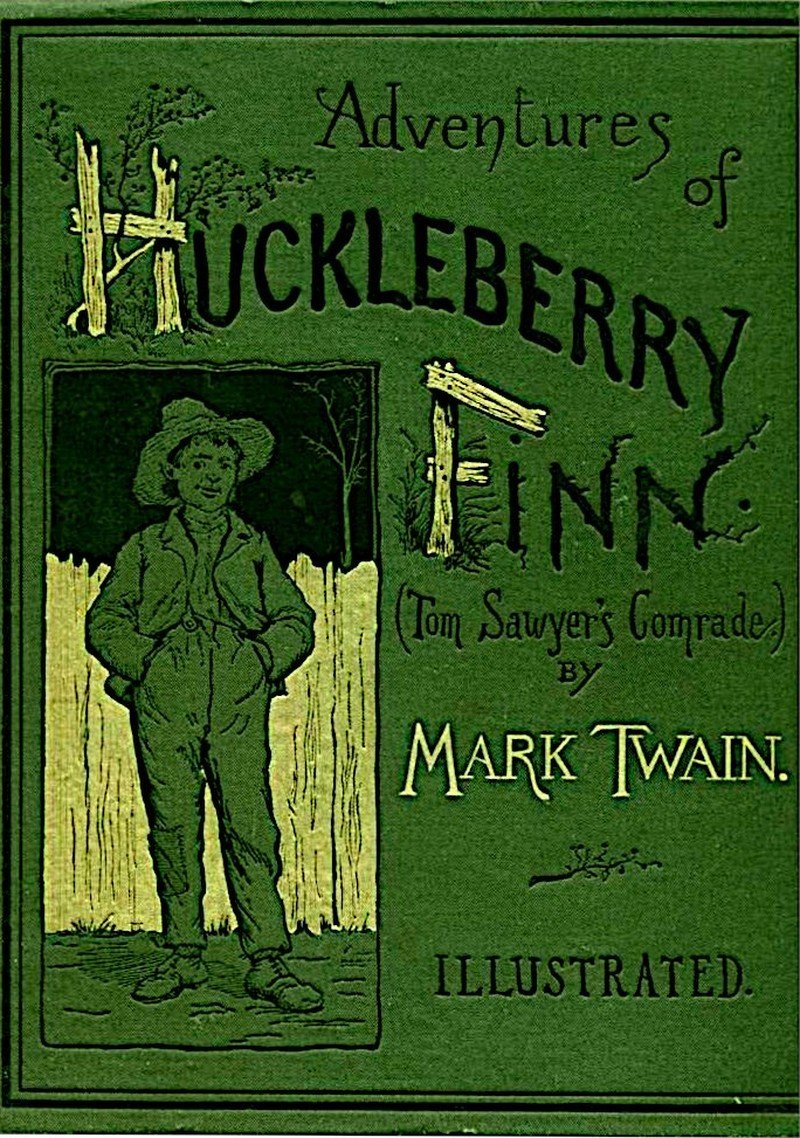
Adventures of Huckleberry Finn (censored)
Twain's Mississippi novel with the racial slur replaced throughout — the edition many families and classrooms need in order to read the book at all.
Worth knowing ⓘ
EPUB works on any device · two-minute setup guide → ·listening, print & film links go to Amazon (affiliate)
Reading it together?
The background for parents
The pitch
This is the same novel, the same 1885 first-edition text, and the same 174 E. W. Kemble engravings as our standard edition — with one change. Every instance of the racial slur has been replaced. If the language is what stands between your family or your classroom and this book, this is the version that removes that obstacle.
What changed, exactly
The slur appears 212 times in what Twain wrote. In 205 of them it is replaced with “slave”, which is the conventional substitution and the one the 2011 NewSouth edition used. The remaining seven are replaced with “black man”, because “slave” would make nonsense of them: six occur in Pap’s drunken rant in chapter six, which is entirely about a free Black college professor from Ohio who votes and whom the law will not let anyone sell — the outrage Pap is expressing depends on the man being free. The seventh is the last chapter’s line about Tom taking all that trouble to set a free man free. Nothing else in the text is altered: not the violence, not the dialect, not Twain’s own front matter, not a comma of anyone’s speech.
We think you should know this is an edit, and we’d rather say so plainly than let a reader assume they are holding what Twain published. It is a legitimate edition and a contested one, and both of those things are worth telling a young reader.
What to know
Everything true of the original is still true here: it is the hardest book on this site, it asks to be heard rather than scanned, and it belongs to grade 9 and up. The family discussion guide and the book-versus-movie comparison were written against the standard edition text and apply unchanged to this one — see the book club questions and the book vs. movie page. One practical note: the audiobook and paperback linked above are the unaltered text, because no censored audio or print edition exists.
Life when written
Twain started it in 1876, immediately after finishing Tom Sawyer, then stalled and left the manuscript alone for years. What restarted it was going back: in 1882 he travelled the Mississippi again as a passenger on the river he had once piloted, and found the steamboat world of his boyhood mostly gone. The book he finished looks back at the 1840s, when slavery was legal in Missouri and a boy like Huck would have grown up understanding Jim as someone else’s property — which is the assumption the whole novel is built to take apart. It was published in Britain in December 1884 and in America in February 1885 by Charles L. Webster & Company, Twain’s own firm. Within weeks the public library in Concord, Massachusetts had banned it as coarse and unsuitable, and Twain wrote cheerfully to his publisher that this would sell them several thousand extra copies.
The book vs. the movie
If they like it, read these next
Modern books (still in copyright, so not free) that scratch the same itch.

The closest living relative: an eleven-year-old narrator in 1859, funny for most of its length and then quietly devastating — for the kid who liked that Huck's voice never announces what it's doing.

A boy telling whoppers his way across Civil War America. For the reader who came for the lying, the running, and the tall tales rather than the moral reckoning.
Affiliate links. They never affect our picks.
Prefer a printed copy? Bantam Classics paperback (affiliate links). Not sure whether your reader needs the original or an abridged edition? Our guide to choosing →
Read it on any device
Send the free EPUB to your Kindle with Amazon's free Send to Kindle — it appears in the library like any book.
Opens straight in Apple Books. Tap the file, choose Books, done — great for bedtime read-alouds.
Google Play Books opens it in a couple of taps, and syncs your place across devices.
Apple Books on a Mac, or the free Calibre app on Windows. No account needed.
Quick answers
What age is Adventures of Huckleberry Finn (censored) right for?
We shelve it for grades 9–12 — that's where the language and the length sit for a reader on their own. Read aloud, it works earlier, from about age 11–12 — kids follow a story by ear well before they can read it alone.
Is Adventures of Huckleberry Finn (censored) scary?
Not scary — but violent in places, and morally heavy throughout. This edition replaces the slur; it does not change the subject or any event. The book is still set in a slaveholding society in the 1840s, Jim is still escaping being sold south, a drunk man is still shot dead in the street, a family feud still kills two boys, and Tom Sawyer still stages a weeks-long escape for a man he knows has already been freed. Where Twain's point depends on the man being free rather than enslaved, 'black man' is used instead of 'slave' — seven times. The audiobook and print editions linked on this page are the original unaltered text; no censored audiobook or paperback exists.
Is the free ebook really the whole book?
Yes — the complete, unabridged text, with the original E. W. Kemble illustrations. Adventures of Huckleberry Finn (censored) was published in 1885, so it's in the US public domain: sharing it free is legal, and there's no signup or catch. We build the ebook ourselves from the original edition.