The pitch
Rip Van Winkle is idle, kind, hen-pecked and much loved by everyone in the village
except the woman he lives with. He goes up the Kaatskills with his gun and his dog to
get away from her, meets a silent old man in Dutch clothes carrying a keg, helps him
up the mountain, drinks with the strangers he finds there, and falls asleep. When he
wakes his gun has rusted through, his dog is gone, and his beard is a foot long. The
village below has a new name over the inn door and a flag nobody has explained to him.
What to know
It is one story, about eight thousand words, and most kids finish it in a sitting —
which makes it the shortest thing on this shelf and a good first classic for a reader
who bounces off long books. The plot is simple; the sentences are not. Irving writes
1819 English, long and looping, with a joke folded into most of it, and a grade-4
reader will meet words to ride past. Read aloud it goes easily from about seven. This
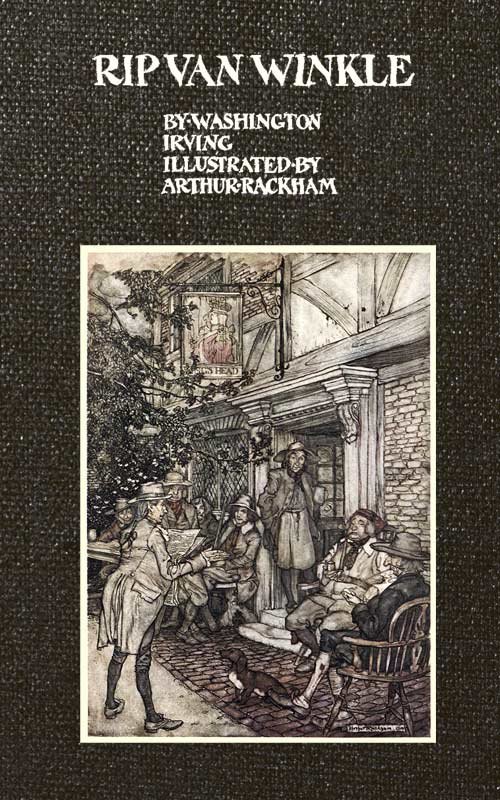
edition is Arthur Rackham’s — the same illustrator as our Alice — from Heinemann’s
1916 reissue of his 1905 Rip Van Winkle: twenty-four colour plates plus his in-text
drawings and tailpieces, several of them signed and dated in the plate. The book keeps
its own front matter, which most reprints cut: the introduction Irving wrote in the
voice of the invented historian Diedrich Knickerbocker, the note where Knickerbocker
swears the whole thing is true, and the postscript of mountain folklore.
Life when written
Irving wrote it in Birmingham, England, in 1818, in a house full of his sister Sarah’s
family, after the import business he and his brothers ran collapsed and left him
thirty-five years old with no profession and no money. The story is said to have come
out of an evening’s talk with his brother-in-law about home. He had never been to the
Catskills in his life — he wrote the mountains from the Hudson valley of his boyhood
and from other people’s descriptions, in a city of foundry smoke three thousand miles
away. The tale he reshaped was German, about a goatherd named Peter Klaus, and Irving
planted the clue himself rather than cover it: the note at the end has Knickerbocker
admitting the story resembles a German superstition about an emperor asleep under a
mountain. It was published in 1819 in the instalments that became The Sketch Book,
and it made him the first American writer Europe read seriously.