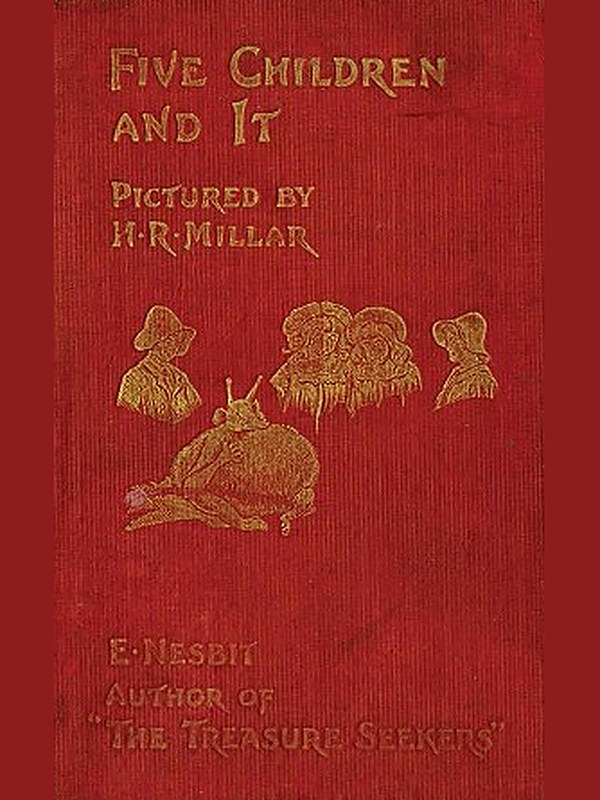
The pitch
Four children and a baby take a house in the country for the summer, dig in the
gravel-pit for something to do, and turn up something ancient and irritable: a
sand-fairy, all fur and snail’s eyes, that grants one wish a day and accepts no
responsibility whatever for the results. The wishes are reasonable enough — to be
beautiful, to be rich, to have wings — and each one is a catastrophe by teatime.
Then the sun goes down, everything is undone, and they walk back to the pit the
next morning to try again.
What to know
Eleven chapters, each one a complete wish and its collapse, which makes this a
natural chapter-a-night book and an unusually good one to read aloud — the comedy
is broad enough that a six-year-old listener laughs in the same places a
ten-year-old reader does. The English is Edwardian and a little formal, and the
slang has to be taken on trust (“it’s a pretty decent average ghastly mess this
time”), so a grade-4 reader wants a running start and a grade-6 reader flies.
Our edition is the complete 1905 Dodd, Mead first American text, carrying all
forty-seven of H. R. Millar’s original drawings — the ones Nesbit’s first readers
saw, several still signed and dated in the plate — along with her verse dedication
to her youngest child. Chapter ten, in which Cyril wishes for Red Indians and gets
them, is dated straight through; the content note has the specifics, and flags
the rest.
Life when written
Nesbit wrote this at Well Hall, an eighteenth-century house at Eltham in Kent
that the family had moved into in 1899 and where she went on to write nearly all
her children’s books. It ran first as a serial through 1902 in the Strand
Magazine — the monthly that had made Sherlock Holmes a household name — under the
title “The Psammead,” which is why this edition still carries her note saying so.
The setting is the ground outside her own door: chalk quarries and gravel-pits
were ordinary working landscape in that part of Kent, the sort of thing a family
took a summer house near without thinking about it, and a child could dig in one
all day and nobody minded. She dedicated the book to John, the youngest in her
house, who was three, and who — as the poem admits — had not learned to read a
word of it.